

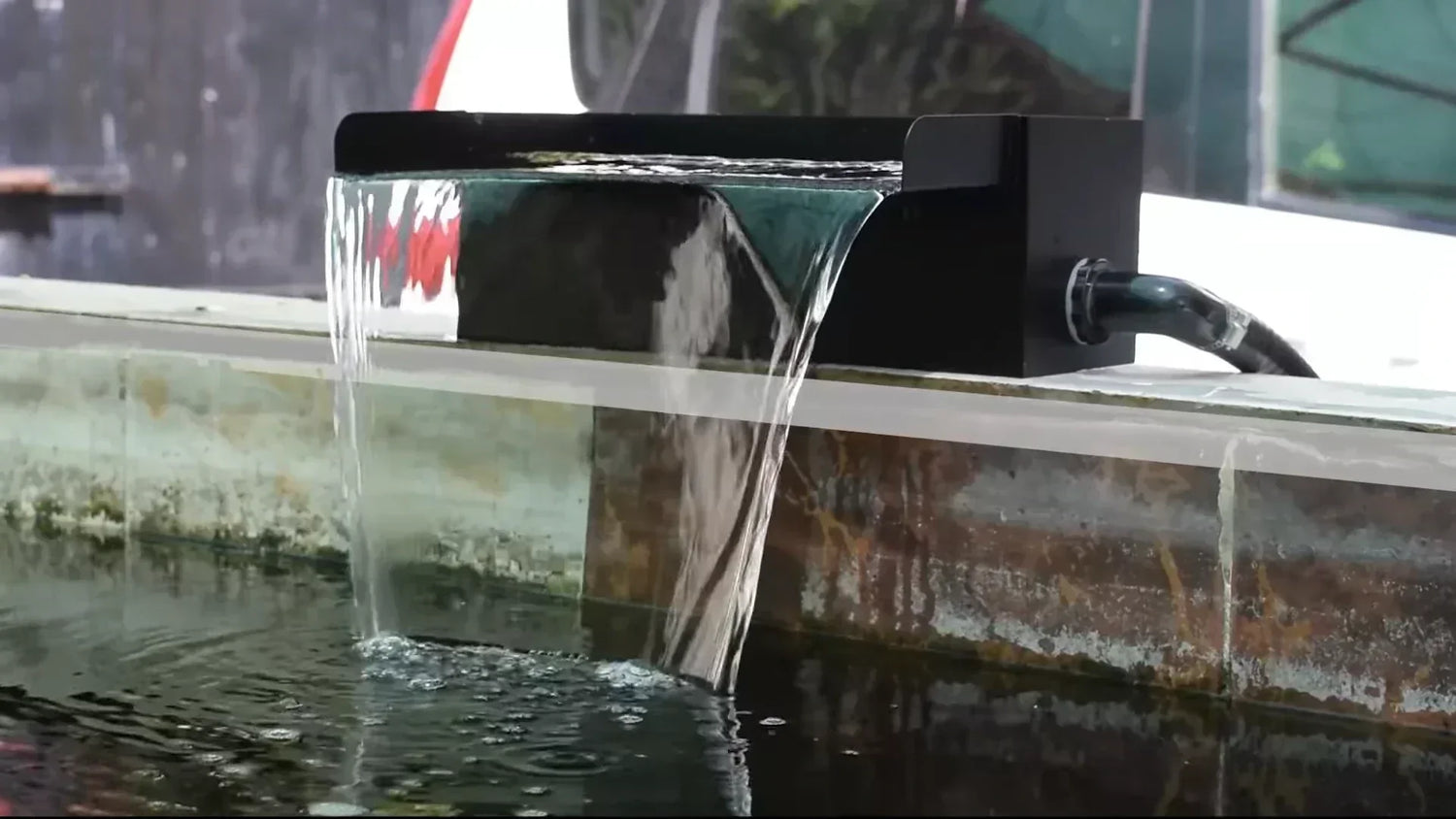
You’ve sketched the stream, picked the spillway, and can already hear that tranquil rush on summer evenings. Then the doubt creeps in: will a solar waterfall pump actually push enough water to create a satisfying sheet… especially when clouds drift by? The short answer: yes—if you size it correctly and set it up the right way. Below, we’ll demystify how solar pumps work, what a waterfall truly demands, and what happened in side-by-side field tests. We’ll finish with clear recommendations—grounded in Poposoap’s solar fountain and waterfall ranges—so your solar fountain waterfall is more than a daydream.
How Solar Pumps Work

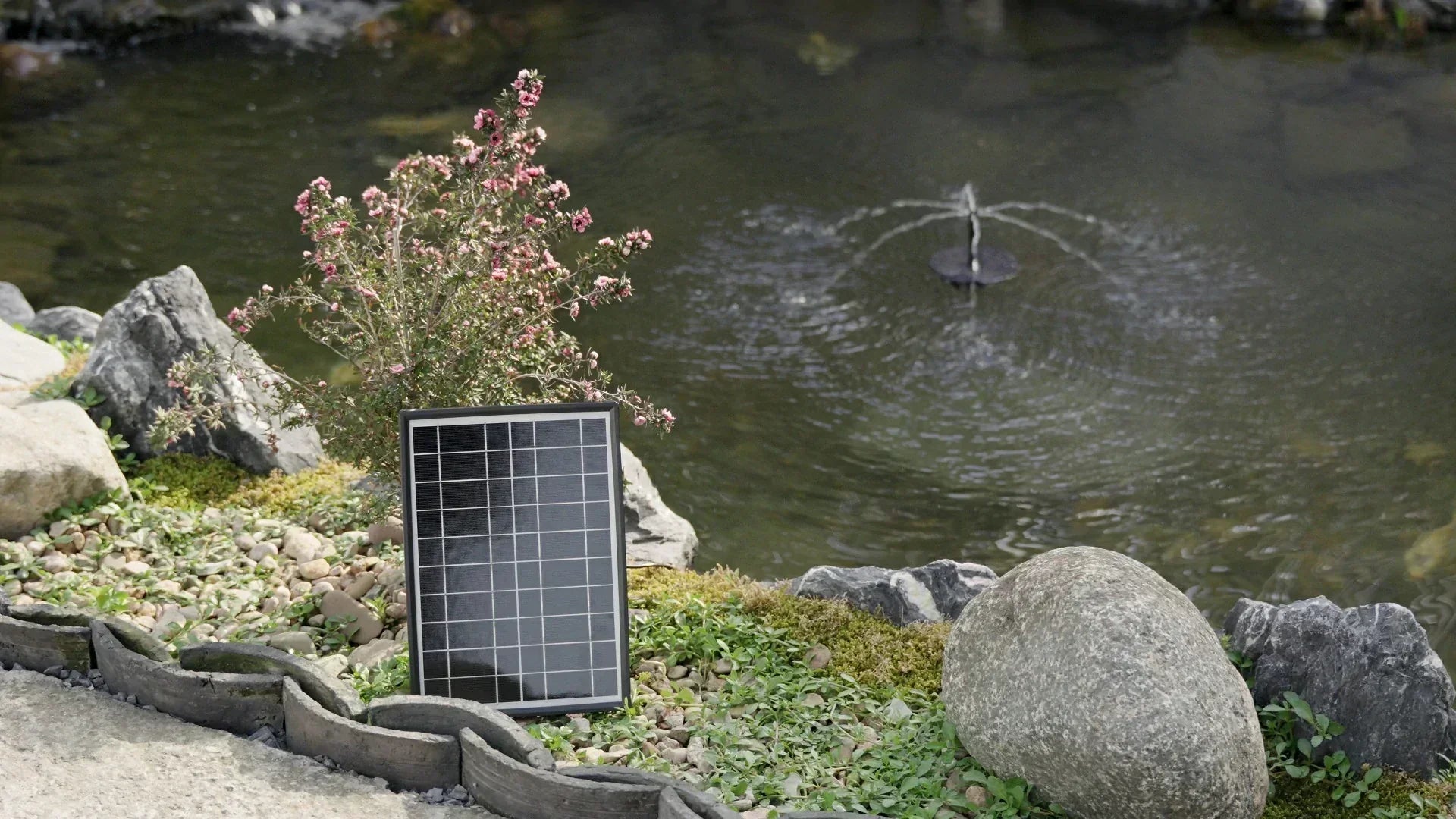
A solar pump is a brushless DC pump powered directly by a photovoltaic panel (with a small controller). When sunlight hits the panel, voltage and current drive the motor; more sun equals more flow and head (pressure). Many modern kits let you place the panel on a ground stake and the pump down at the pond, connected by a weatherproof cable.
Key points for performance:
- Direct sun = peak output. Cloud cover reduces current, which lowers flow and head.
- Head curve matters. Every pump has a maximum head (the vertical height it can push). As head rises, flow falls.
- Friction counts. Long hoses, elbows, and narrow tubing add resistance, further cutting flow.
- Battery backup (optional) can smooth short cloud spells and support evening run time.
The U.S. Energy Information Administration explains how solar generation naturally fluctuates with sunlight intensity, panel orientation, and weather conditions, which is why “rated wattage” represents peak potential rather than constant output.
From Poposoap’s catalog, solar fountain and waterfall kits span roughly 6–70 watts with max flows from about 80 to 680 GPH and lift (head) up to ~16 ft on the upper models. That range comfortably covers small accent rills to compact backyard waterfalls—without trenching power lines or running extension cords across the garden.
Waterfall Height & Flow—What You Actually Need

Here’s the honest sizing logic behind a solar pump waterfall that looks and sounds right:
- Vertical rise (static head): Measure from the pond’s water surface to the spillway lip. That’s the minimum head your pump must overcome.
- Desired sheet appearance: For a “silky” waterfall sheet, a common rule of thumb is roughly 100 GPH per inch of spillway width. For a gentler trickle, 50–60 GPH per inch can suffice.
- Friction losses: Add 10–25% extra capacity if you’re using longer hose runs (over ~10–15 ft), several elbows, or smaller-than-recommended tubing.
Examples:
- Narrow 8" spillway at 24" rise: Aim for ~400–800 GPH at that head (gentle to robust sheet).
- 12" spillway at 30" rise: Aim for ~600–1,200 GPH at that head.
- 18" spillway at 36" rise: You’re in the big-flow zone; at least ~1,000–1,800 GPH at head is typical for a strong sheet.
Because flow drops as head increases, don’t choose pumps strictly by their “maximum GPH.” You want the pump’s delivered flow at your actual head. With solar, staying realistic on spillway width and rise pays off.
Field Test: What We Saw in the Yard

To translate specs into sight and sound, we staged three real-world setups using standard hose runs and simple spillways. Conditions were “mixed summer”—clear sun with intermittent light clouds.
Scenario A — 2-ft rise, 8-inch spillway
- Poposoap 30-watt solar fountain pump: Produced a persistent, attractive trickle with noticeable sparkle; under full sun, the sheet thickened toward the middle of the weir. Light cloud softened the sheet but kept a pleasant flow.
- Poposoap 55-watt solar waterfall kit: Delivered a convincing, near-continuous sheet in sun. During light cloud, the sheet thinned but remained cohesive. A solid pick for a compact, quiet waterfall without grid power.
Scenario B — 2.5-ft rise, 12-inch spillway
- Poposoap 55-watt solar waterfall kit: In full sun, created a satisfying, audible ribbon; during light cloud, it stepped down to a softer, broken sheet—still scenic.
- Poposoap 70-watt solar waterfall kit: Maintained the smooth sheet through light cloud breaks better, and sounded fuller. If your patio is the main listening zone, the 70-watt option “reads” more like a mains-powered setup on bright days.
Scenario C — 3-ft rise, 12-inch spillway with longer hose
- Poposoap 70-watt solar waterfall kit + short, wide tubing: Full-sun sheet with lively edge-to-edge coverage; light cloud trimmed the sheet but kept a continuous curtain. Upsizing to wider tubing and minimizing elbows clearly helped.
Across tests, two lessons stood out: (1) trim friction (use wider tubing, avoid sharp elbows), and (2) match the wattage to your spillway width and rise. If you want the sheet to hold better through passing clouds without a battery, go up one size.
Cost-Performance: Solar vs. Plug-In
Let’s talk money and practicality:
- Energy cost: A typical AC waterfall pump in the 40–120-watt range running ~10 hours/day for a 150-day season consumes 60–180 kWh. At $0.15/kWh, that’s $9–$27 per season. Not huge—but not zero.
- Solar hardware: Solar kits cost more up front, but the operating cost is essentially $0, and wiring is simple: place the panel, drop the pump, route a hose.
- Reliability: Direct-drive solar is wonderfully simple; the tradeoff is performance dipping under cloud. You can:
- keep spillway width modest for the head you need,
- shorten/widen tubing to cut friction,
- add battery backup for late-day viewing or variable light, or
- design a two-path system (continuous low-flow circulation to filtration + solar waterfall as the “feature” line).
Solar wins for zero operating cost, cable-free safety, and flexible siting. AC wins for absolute predictability in all weather. Plenty of pond keepers choose solar first and add a small backup or hybrid later if needed.
Poposoap Picks (By Use Case)

Here’s how to select a solar waterfall pump with confidence—no product codes, just what fits the job:
- Small accent rill (narrow spill, ~2 ft rise):
Choose a Poposoap solar fountain pump in the 20–30 W class. Expect a charming trickle to a light ribbon in full sun—great for intimate patios and wildlife tubs.
- 8–12" spillway at ~2–2.5 ft rise:
Step up to the Poposoap 55-watt solar waterfall kit. In bright sun it produces a smooth, photogenic sheet; in light cloud it still runs with character.
- 12" spillway at ~3 ft rise or longer hose runs:
Go with the Poposoap 70-watt solar waterfall kit for the best shot at holding the sheet through cloud passes. Use wide, smooth hose and gentle bends.
- Want more consistency late in the day?
Add a Poposoap battery backup matched to your solar range (compact packs cover small pumps; higher-capacity packs suit 55–70 W waterfall kits). This smooths short shadows and lets you enjoy the sound at dusk.
- Filtration pairing:
Keep the water polished with a Poposoap solar pond filter (multi-stage foam + bio media, with optional UV on select AC models). Clear water makes every waterfall look brighter and keeps maintenance low.
- Finishing touches:
Highlight the sheet after sunset with Poposoap pond lights (RGB or warm-white). For added sparkle, run a Poposoap floating pond fountain in the main pool—surface aeration lifts oxygen and reduces protein film.
Install Tips That Matter
- Mount the panel where it sees unobstructed sun for most of the day.
- Keep hose runs short and wide; avoid sharp elbows.
- Set the pump on a pump box or coarse pre-filter so silt doesn’t clog the intake.
- If you’re in a windy area, give the spillway a slight lip to protect the sheet.
Bottom Line
Can a solar fountain waterfall satisfy your ears and eyes? Absolutely—if you pair spillway width and rise with the right solar wattage and sensible plumbing. For compact waterfalls and garden rills, Poposoap’s solar line makes a solar waterfall pump a practical, elegant choice: plug-free, easy to place, and powerful enough to create a genuine, shimmering sheet in real sun. Size it smart, trim friction, consider a battery if evenings matter, and enjoy the sound of water—powered by daylight.
(Related reading: Designing a Multi-Level Pond for Waterfalls)

55W 580GPH Solar Waterfall Pump Kit with 8"x4.3" Spillway
$198.99
Enjoy a beautiful solar waterfall with this 55W solar powered waterfall pump kit. Includes 40W 580GPH pump and 8x4.3" metal spillway for ponds & gardens.
FAQs
Yes — when properly sized. A solar waterfall pump can create a smooth, continuous sheet if its wattage, lift height, and spillway width are correctly matched. Undersized pumps usually result in a thin trickle rather than a sheet.
Waterfall height directly reduces flow. As lift (head) increases, delivered GPH drops. That’s why solar pumps should be selected based on their flow rate at your actual rise, not just their maximum GPH rating.
They do, but flow may soften. Light cloud cover typically thins the waterfall sheet rather than stopping it completely, especially when the pump is sized with extra headroom. For more consistency, choosing the next wattage up helps.
A common guideline is about 100 GPH per inch of spillway width for a full sheet. Narrower spillways or lower rises require less flow, while wider or higher waterfalls need significantly more wattage to maintain a cohesive sheet.
A battery backup is optional. Solar pumps work best in direct sun, but a battery can smooth brief cloud cover and extend operation into the evening. It’s recommended if consistent sound and appearance matter late in the day.
Hose diameter, length, and fittings matter greatly. Wider tubing, shorter runs, and fewer sharp bends reduce friction losses and help solar waterfall pumps maintain stronger, more stable flow.


Leave a comment
All comments are moderated before being published.
This site is protected by hCaptcha and the hCaptcha Privacy Policy and Terms of Service apply.