

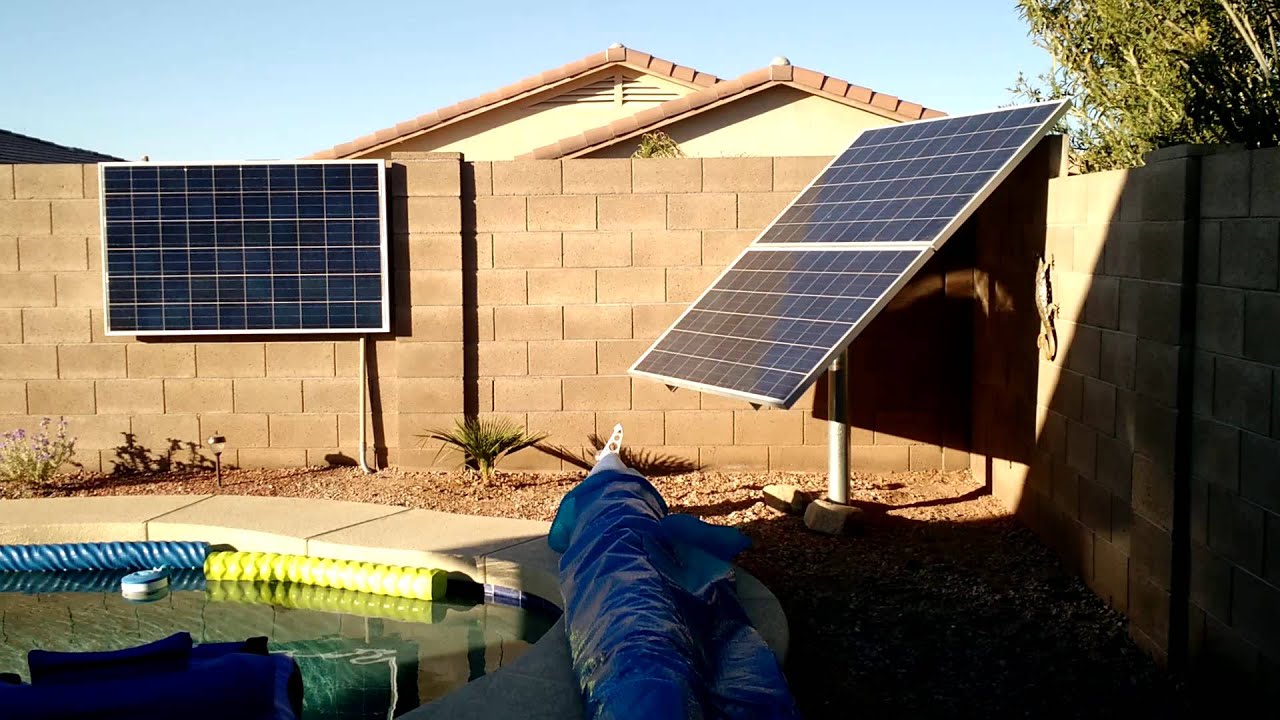
Operating a pool pump can be costly in terms of electricity usage, but using solar panels for swimming pools can significantly reduce those costs while benefiting the environment. The big question for any pool owner is: how many solar panels to run a pool pump? This article will guide you through the steps for calculating the energy your pool pump requires and how many solar panels you need to power it efficiently.
Key Takeaways:
- Use your pump's watt rating and operating hours to calculate the energy consumption.
- Know your peak sun hours: Peak sun hours are the number of hours your solar panels for swimming pools receive maximum sunlight.
- Divide your pool pump’s energy requirements by the peak sun hours to estimate the size of the solar system you need.
- Add about 14% for efficiency losses due to weather and panel orientation.
- Finally, divide the adjusted system size by the wattage of a solar panel for water pump to determine the number of panels required.
How Does a Solar Pool Pump Work?
A solar powered pool pump uses energy harnessed from the sun, converted by pool solar panels into electricity to power the pump. The pump circulates water through the pool's filter system, keeping the pool clean without drawing energy from the electric grid. This saves money and is an environmentally friendly solution. These swimming pool solar panels can be installed on the roof or in a sunny area in your yard.

Step 1: Calculate Your Pool Pump's Energy Consumption
The first step is to calculate how much energy your pool pump consumes in a day. Pool pumps are typically rated in horsepower, but for energy calculations, we convert that into watts. Since one horsepower equals 745.7 watts, a 2-horsepower pool pump will use:
Wattage = 2 HP × 745.7 = 1,491.4 watts
Now, determine how many hours your pool pump runs daily. Most pumps run between 6 and 8 hours per day, depending on the pool's size and water turnover rate. For this example, let’s use 6.5 hours of daily operation:
1,491.4 watts × 6.5 hours = 9,694.1 watt-hours (or about 9.7 kWh/day)
Step 2: Determine Your Location's Peak Sun Hours
Solar panels for swimming pools do not generate at full capacity every hour of the day. The number of peak sun hours is the time when the intensity of solar radiation is about 1,000 watts per square meter. For instance, Los Angeles, California, receives around 6 peak sun hours daily.
| State | Peak Sun Hours | State | Peak Sun Hours |
|---|---|---|---|
| Alabama | 4.5-5 | Louisiana | 4.75-5.25 |
| Alaska | less than 4-4.25 | Maine | less than 4-4.25 |
| Arizona | 5.25-more than 5.75 | Maryland | less than 4-4.5 |
| Arkansas | 4.5-5 | Massachusetts | less than 4-4.25 |
| California | 4-more than 5.75 | Michigan | less than 4-4.25 |
| Colorado | 4-5.5 | Minnesota | less than 4-4.25 |
| Connecticut | 4-4.25 | Mississippi | 4.5-5.25 |
| Delaware | 4-4.5 | Missouri | 4-4.75 |
| Florida | 4.75-5.5 | Montana | 4-4.5 |
| Georgia | 4.25-5.25 | Nebraska | 4-5 |
| Hawaii | 4-more than 5.75 | Nevada | 4.25-more than 5.75 |
| Idaho | less than 4-4.5 | New Hampshire | 4-4.25 |
| Illinois | 4-4.5 | New Jersey | 4-4.5 |
| Indiana | 4-4.5 | New Mexico | 5-more than 5.75 |
| Iowa | 4-4.5 | New York | 4-4.25 |
| Kansas | 4.25-5.25 | North Carolina | 4.25-5 |
| Kentucky | 4-4.75 | North Dakota | less than 4-4.25 |
| Ohio | less than 4-4.25 | Texas | 4.5-more than 5.75 |
| Oklahoma | 4.5-5.5 | Utah | 4-5.75 |
| Oregon | less than 4-5 | Vermont | less than 4 |
| Pennsylvania | less than 4-4.25 | Virginia | 4-4.75 |
| Rhode Island | 4-4.25 | Washington | less than 4-4.5 |
| South Carolina | 4.5-5 | West Virginia | less than 4-4.5 |
| South Dakota | less than 4-4.75 | Wisconsin | less than 4-4.25 |
| Tennessee | 4.25-4.75 | Wyoming | less than 4-5 |
Data source: NREL
Step 3: Sizing the Solar System You Need
To calculate the size of the solar for swimming pools system needed, divide your daily energy consumption by the peak sun hours in your area:
Size of solar system = 9.7 kWh ÷ 6 peak sun hours = 1.62 kW
This means you would need a solar system capable of producing 1.62 kW to power your pool pump.
Step 4: Consider Solar System Losses
Solar systems can lose efficiency due to shading, panel orientation, or weather conditions. To account for this, add a buffer of about 14% to the system size:
Adjusted solar system size = 1.62 kW × 1.14 = 1.85 kW
Step 5: Calculate the Number of Solar Panels
Finally, to determine how many solar panels to run a pool pump, divide the adjusted system size by the wattage of a single panel. Solar panels typically range from 250 to 400 watts, but for this example, we will use 300-watt panels:
Number of panels = 1.85 kW ÷ 0.3 kW = 6.17 panels
Since you cannot install a fraction of a panel, round up to 7 panels. You will need 7 pool solar panels to run your pool pump efficiently.
Conclusion
To power your pool pump using solar energy, you will need approximately 7 solar panels, each producing 300 watts. This is a general estimate, and factors like your geographic location, pool size, and pump wattage can affect the final number. For precise sizing and system design, it's recommended to consult with a professional solar installer who can tailor a system specifically for your needs.
Switching to solar powered pool pumps can significantly reduce your electricity bills and environmental impact. With the right setup of solar panels for swimming pools, you can keep your pool clean and ready for a swim without relying on costly grid electricity. Investing in solar for swimming pools is not only a cost-effective solution but also a sustainable one that contributes to a greener planet.

Make the Switch to Solar Today with Poposoap!
At Poposoap, we offer high-efficiency solar panels and pumps designed to help you save money while protecting the environment. Our solar pool pumps are durable, eco-friendly, and come with easy installation options. Ready to reduce your energy bills and embrace sustainability? Shop Poposoap’s solar-powered pool pumps and accessories now to power your pool with the sun’s free energy!

70W 580GPH Solar Waterfall Pump Kit with 12"x13.4" Spillway
$269.99
Create a beautiful solar waterfall with this 70W kit. Includes a 12"x13.4" metal spillway and 40W 580GPH pump for eco-friendly backyard pond designs.
FAQs
Calculate your pump’s daily energy consumption (wattage × daily operating hours), divide by your location’s peak sun hours, add 14% for efficiency losses, then divide by a single solar panel’s wattage (round up for whole panels).
Peak sun hours are hours when solar radiation hits 1,000 watts per square meter; they determine how much energy solar panels produce, directly impacting the number of panels needed for a pool pump.
The 14% buffer accounts for efficiency losses from shading, panel orientation, weather conditions, ensuring the solar system can still power the pool pump reliably.
A solar pool pump uses electricity converted from sunlight by solar panels to power the pump, circulating pool water without grid electricity, saving costs and benefiting the environment.

Leave a comment
All comments are moderated before being published.
This site is protected by hCaptcha and the hCaptcha Privacy Policy and Terms of Service apply.