

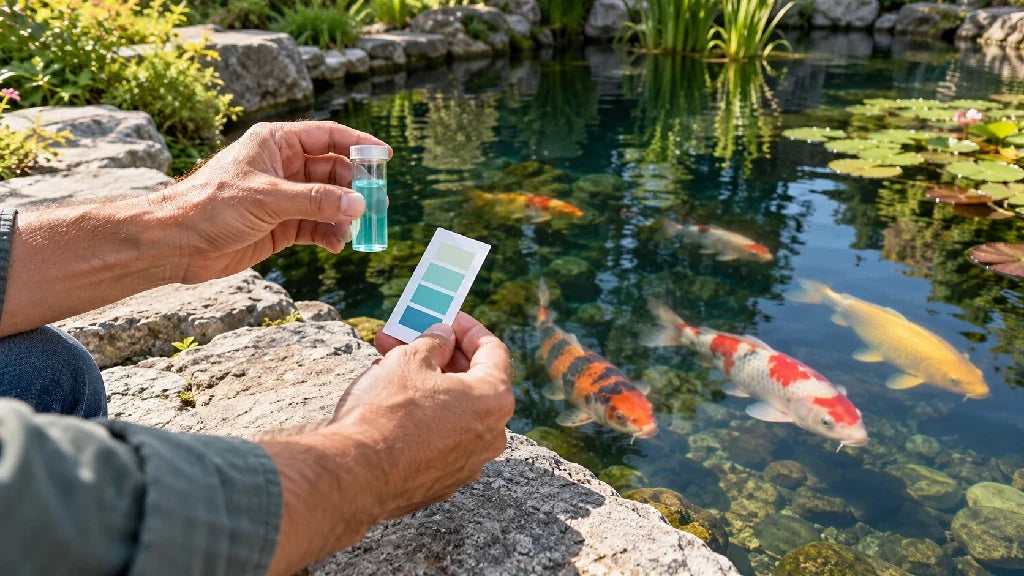
While pond owners monitor water clarity, clean filters, and feed fish, many forget about one parameter – KH. To learn how to maintain proper levels of pond KH, one needs to know the meaning of this term and understand what KH is in a pond. Such a water parameter influences pH, bacteria, and the health condition of koi and other fish. The lack of proper KH levels will complicate the water management process.
What Is KH in a Pond?
KH in a pond is the carbonate hardness that shows the level of carbonate and bicarbonate ions in the water. They function as a buffer and help to regulate the pH levels of water.

Carbonate Hardness and Pond Stability
The pond water changes all the time.
Fish generate waste. Plants consume nutrients and grow. Bacteria decompose organic matter.
Rainwater can change the mineral composition of the pond.
During these processes, the pH of the water fluctuates. An adequate level of KH helps to prevent this problem.
When KH is stable:
- Beneficial bacteria work properly;
- Fish are not under stress;
- It becomes easier to maintain water quality.
Too low a KH level is one of the common causes of unstable pH, especially in the case of koi ponds due to the sensitivity of koi to changes.
KH vs. General Hardness

Both terms sound similar and are connected with water minerals. However, they are different.
KH (carbonate hardness) shows the concentration of carbonate and bicarbonate ions. It affects only pH stability.
GH (general hardness) determines the presence of calcium and magnesium ions. This measurement influences the mineral content and the general hardness of the water.
In this way, the pond can have high GH but too low KH. It means that the water has minerals but does not contain enough buffering agents.
These measurements give additional information about the water and its stability.
Why KH Matters for Koi and Pond Fish
Koi and other pond fish require stable water conditions.
Even slight changes in pH can provoke stress in fish, although the water is clear.
A healthy KH level helps to:
- Stimulate the biological filtration process (the bacteria filter the water);
- Provide stable pH;
- Create a safe environment for fish.
So, monitoring KH is an essential part of pond maintenance for koi keepers.
What Is the Ideal KH Level for a Pond?
The optimal KH level depends on the type of pond, fish, and water source. However, most owners strive to maintain 100–200 ppm of carbonate hardness.
The stability of the parameter is more important than the exact number.
Ideal KH Level for Koi Ponds
For koi ponds, the recommended KH level is around 100 ppm or higher.
Koi ponds need higher carbonate hardness due to the following reasons:
- The fish generate a large quantity of waste;
- The additional feeding increases the organic materials;
- The advanced filtration systems require active bacteria.
If you have many koi in a small pond, then monitoring KH becomes crucial.
Signs That Pond KH May Be Too Low
Low KH can cause unstable water conditions.
The possible symptoms are the following:
- Big pH fluctuations from morning to evening;
- Fish become inactive;
- Appearance of algae;
- Poor performance of biological filtration.
Nevertheless, such signs can be symptoms of other problems with the water. Only testing can show you whether the KH is low.
What Happens When KH Is Too High?
High KH is less dangerous than low KH since stable water is better for fish.
However, very high KH can make it difficult to regulate other water parameters.
The task is not to make perfect parameters. The task is to keep stable conditions in the pond.
How to Test and Monitor Pond KH
Regular testing is the safest way to know the state of the pond water.
KH can change after weather changes, water changes, or changes in pond conditions.
Testing with the Help of Pond Test Strips or Liquid Test Kits
There are two common methods to test KH:
-
Test strips
They are easy to use and convenient for quick tests.
-
Liquid test kits
They give more detailed results and are preferred by serious pond owners.
Follow the instructions to get the correct results with any method.
When to Test Pond KH
Good times for KH testing are the following:
- After heavy rain;
- After the addition of new water;
- After major cleaning of the pond;
- When fish appear to be under stress;
- During seasonal changes.
Rainwater can decrease the KH level since it often does not contain enough minerals compared to pond water.

Testing KH Together with pH, Ammonia, and Nitrite
It is necessary to check KH along with other important water parameters.
The other parameters include:
- pH;
- Ammonia;
- Nitrite.
For instance, a low KH level makes it difficult for beneficial bacteria to perform their work. It can influence the levels of ammonia and nitrite.
A simple testing record will help to detect trends and prevent problems before they arise.
How to Increase or Lower Pond KH Safely
The safest way to adjust KH levels is to make small changes gradually.
Big changes create additional stress for fish.

How to Increase KH in a Koi Pond
To learn how to increase KH in a koi pond, it is necessary to add carbonate compounds.
The common substances for the process are the following:
- Crushed coral;
- Limestone-based substances;
- Sodium bicarbonate (baking soda).
Do not forget to test the KH level first.
The required quantity of substances depends on:
- Pond size;
- Current KH value;
- Number of fish in the pond;
- Water source.
Baking Soda for Pond KH Adjustment
It is possible to increase KH using baking soda. It is a popular practice among pond keepers.
This substance increases carbonate hardness and improves the buffering capacity.
However, it should not be added without testing.
Good practices are:
- Add small amounts gradually;
- Give time to adapt to the changes;
- Test the water after the treatment;
- Avoid abrupt changes.
How to Lower General Hardness Safely
The majority of pond owners are looking for how to lower general hardness, but it requires special attention and additional effort.
The possible ways are the following:
- Mixing hard water with soft water;
- Using filtered rainwater;
- Making controlled water changes.
The correct way depends on local water conditions.
Do not try to lower the hardness without any reason.
Common Mistakes When Adjusting Pond Water
The common mistakes are the following:
- Adding the product without testing;
- Making fast changes;
- Following another pond owner's dosage;
- Ignoring regular maintenance.
Every pond is unique. The adjustment should be done individually for each situation.
Keep Pond KH Stable for Healthier Water
Maintaining stable KH is one of the basics of pond maintenance. Appropriate carbonate hardness guarantees stable pH, bacterial activity, and healthy conditions for koi and other fish.
Try to avoid numerous corrections and concentrate on regular testing, maintenance, and pond management.
A properly designed pond system can simplify the maintenance process. Efficient circulation and filtration create cleaner conditions, while reliable equipment reduces the daily routine. Poposoap offers practical solutions to create water features and make your garden ponds healthy and easier to maintain.
A healthy pond is not about perfect numbers. It is about creating stable conditions for fish, plants, and bacteria.

20W Solar Pond Filter & Fountain Kit
Built-in 280 GPH water pump, filter box and bio-filter media – ideal for maintaining excellent water quality in ponds.
Shop NowFAQ
What does KH mean in a pond?
It is the carbonate hardness that regulates pH fluctuations in the pond.
What is a good value for KH in a koi pond?
Generally, all koi ponds have at least 100 ppm of KH. Stability is more important than an exact value.
Is it possible to use baking soda to increase pond KH?
Sure, but baking soda has to be used after testing.
How often do I need to test KH in my pond?
Regularly, especially when there has been heavy rain or you've made water changes.


Leave a comment
All comments are moderated before being published.
This site is protected by hCaptcha and the hCaptcha Privacy Policy and Terms of Service apply.