

Most people consider the term "pond" to mean a beautiful garden decoration.
However, in some locations, ponds have an entirely different purpose—an agricultural one.
For instance, ponds play a role in fish farming, irrigation, and agricultural land management.
Ponds are not just decorations.
In fact, there are many different pond types, each serving a particular purpose.
In this article, we will discuss several pond types suitable for fish farming.
Understanding the advantages and limitations of various pond types allows you to choose the best pond solution.
Common Types of Fish Ponds and Their Uses
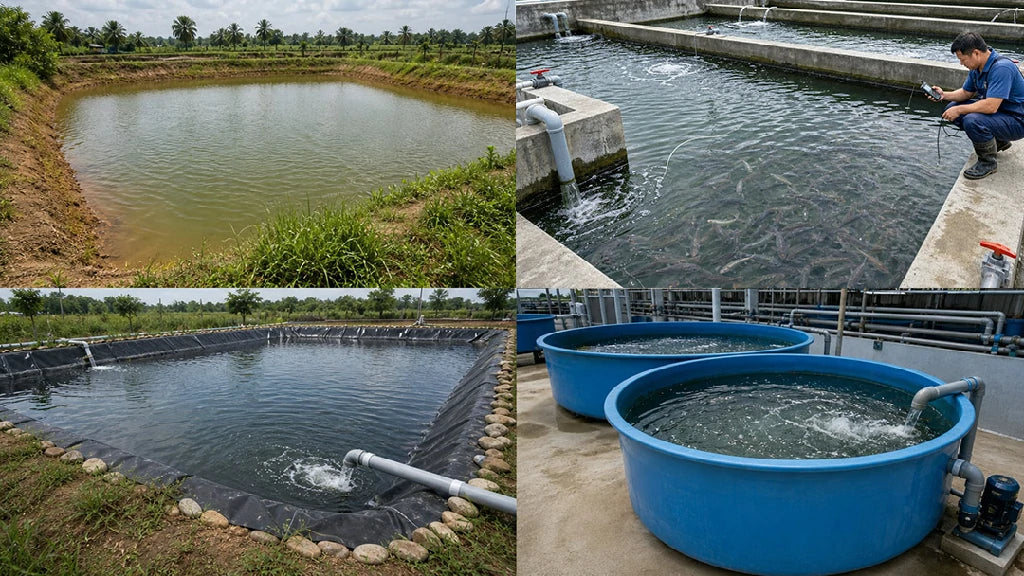
Earthen Fish Pond (Traditional Fish Farming Ponds)

This fish farming pond type consists of a dug-out area in the ground.
The soil acts as a wall holding back the water.
This is a very old fish pond type that is still in use in many fish farms.
Advantages:
- Low construction cost
- Natural materials
- Good for large-scale operations
Limitations:
- Leaks are possible if the soil is loose
- Challenging to maintain water quality
- Subject to environmental impact
In my experience, earthen fish ponds tend to work best in the countryside.
They are practical in situations where land area is readily available.
Concrete Fish Pond (High-Density Fish Pond Types)

As implied by the name, concrete ponds are artificial ponds.
The walls and bottom floor of such ponds are made of concrete.
These are frequently used in commercial fish farms because they support higher fish densities.
Advantages:
- Durability
- Easy maintenance
- Greater control over water conditions
Limitations:
- Relatively high costs
- Professional installation required
- Less natural environment
High-density fish farm pond types are common where space is limited and greater control is required.
Modern Fish Pond Types for Better Control
Lined Fish Pond (Flexible Fish Farming Ponds)

A relatively new technology, lined ponds rely on liners rather than soil to hold water.
Liners prevent water leakage.
Typically, the liner material is plastic or rubber.
Advantages:
- Prevents water loss
- Suitable for any soil type
- Easier water quality maintenance
Limitations:
- Installation required
- More expensive than earthen ponds
These ponds are increasingly popular because they provide flexibility.
Pond liners can significantly increase the durability of earthen ponds.
Fiberglass or Tank Ponds (Compact Fish Pond Types)

Fiberglass ponds are pre-made ponds that come ready to use.
Fiberglass or tank ponds are popular for breeding and experimental purposes.
These are commonly used for research, breeding, and high-end fish farming.
Advantages:
- Quick installation
- Easy water condition management
- Ideal for limited spaces
Limitations:
- Smaller size
- Costly at scale
- Cannot be used efficiently for large-scale production
This pond type is popular among beginners and hobbyists because of its relatively low maintenance requirements.
Choosing the Right Fish Pond Type
Each pond type serves a particular purpose and has its own advantages and disadvantages.
There is no one-size-fits-all solution.
To simplify your decision-making process, consider the following:
- Earthen fish ponds → Suitable for large-scale, low-cost fish farming
- Concrete ponds → Good for intensive fish farming operations
- Lined ponds → Offer a strong balance between cost and water control
- Fiberglass or tank ponds → Best for experimental or limited-scale operations
Whichever fish pond type you choose, remember to keep water clean and stable.
A filtration system is an excellent tool for achieving this goal.
Before making your decision, think about:
- Available land
- Your budget
- Water source availability
- Scale of operations
These considerations should make your decision easier.
Conclusion
Each fish pond type is suitable under specific circumstances.
Therefore, there is no universal answer.
The simplest and cheapest option is the earthen pond.
Concrete ponds are strong and efficient.
Lined ponds provide a balance between cost and control.
Fiberglass or tank ponds are easy to manage.
Each pond type solves different challenges.
At Poposoap, we provide tools that help simplify pond management.
You can use liners, filtration devices, and other pond equipment to improve pond performance.
For more detailed information about pond equipment, check out [this article].

40W 660GPH Waterfall Pump Kit with 8" Spillway & Light
$137.99
Build a stunning night-view waterfall with POPOSOAP’s all-in-one kit. Features 660GPH pump, 8" spillway & LED lights. Poposoap Your Water Feature In 10 Min.
FAQ
1. What are the main types of fish ponds?
Earthen, concrete, lined, and fiberglass ponds are the most popular types.
2. Which pond is easiest to build?
Earthen ponds generally require the least effort to construct.
3. Why are lined ponds so popular?
Liners prevent water loss and allow better control of water conditions.
4. Do all ponds need filtration?
Yes, most fish ponds benefit from filtration systems to maintain water quality.



Leave a comment
All comments are moderated before being published.
This site is protected by hCaptcha and the hCaptcha Privacy Policy and Terms of Service apply.