

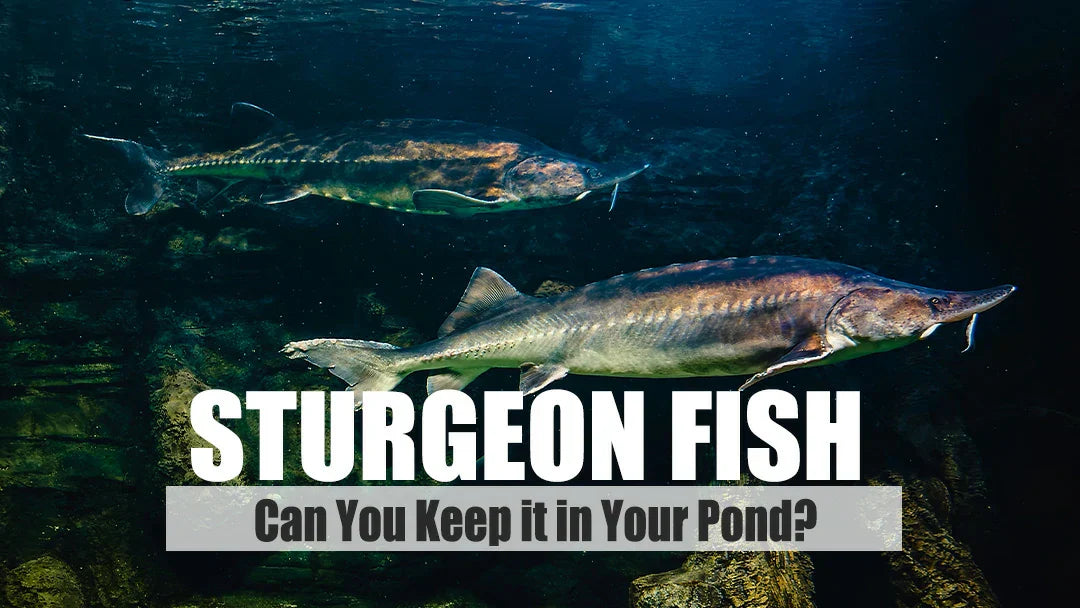
The first time one sees a sturgeon in a private pond, it definitely doesn't look like a "pond fish." Long and slow-moving, with armor plating on the back — it looks like it belongs in a riverbed, not in the backyard.
This is why there are so many people asking the same question: can one keep sturgeon fish in a pond?
The truth is that these are not fish for an average pond, which makes it necessary to answer that while it is definitely possible to keep sturgeon fish in a pond, it has to meet some very particular requirements. Sturgeon fish simply can't be compared with koi or goldfish. They require completely different conditions.
This article should provide you with information on what sturgeons actually are, how a diamond sturgeon or a diamond back sturgeon might be misinterpreted, and what you should take into consideration before actually putting this type of fish in a pond.
What Stands Out About Sturgeon Fish
The sturgeon is an extremely ancient fish. Its lineage goes further back in evolution than most other freshwater fish. This is shown in how they live and how they have managed to thrive.
These fish do not possess scales like koi or goldfish. They possess bony plates called scutes instead. These are designed for traveling long distances through rivers rather than staying near the surface of the water.

Image source: Wikipedia
Also, the feeding behaviors of the two fish exhibit some distinct characteristics:
- Sturgeon fish primarily feed at the bottom, using barbels located around the mouth.
- They cannot compete effectively for food in the top zone.
- They do not possess the trait of "learning" to race to the top for floating foods.
However, the most significant difference is in the amount of oxygen required. Sturgeon need a high amount of dissolved oxygen in the water. If koi can live in low-oxygen conditions for a certain amount of time, a sturgeon would die. This is why many cases in which sturgeon are discovered in a pond do not end well even when there is nothing else wrong.
Diamond Sturgeon, Diamond Back Sturgeon, and the Problem of Name Confusion
If you have done any reading on sturgeon for ponds, you have probably seen that the "diamond sturgeon" and "diamond back sturgeon" terms have essentially been given the same meaning.
The truth is that these are marketing names that the merchant chooses in reference to certain smaller breeds of sturgeons designated as "pond suitable." They do not guarantee anything in terms of ease of care. These sturgeons too can grow very big and live for several decades.
Some consumers might perceive "pond sturgeon" as referring to "slow-growing fish." That is incorrect. These fish start off small but never stay small. Their oxygen demand increases as they become bigger.
There are other species of sturgeon. Most of them are not at all suitable to be raised in ponds. Some of them move from fresh water to salty water and vice versa. Others grow to enormous size. Making the wrong choice would be a most expensive blunder.

The Actual Needs of a Sturgeon Pond
This is where most home ponds fail the test.
A sturgeon's home should be deep, broad, and oxygen-focused rather than aesthetic. This will allow the water to maintain a more consistent temperature. Warm water holds less oxygen.
A lack of oxygen, also known as "oxygen deficiency," is usually the primary cause for which sturgeons die off in ponds. It sometimes occurs silently. When it is summertime, or algae develop, or an overnight pump malfunction results in inadequate oxygen levels, it can be life-threatening.
Good, strong current is critical. Surface agitation, bottom flow, and filtration all influence the effectiveness. A 40W AC Pond Filter Fountain with Light from Poposoap may increase agitation and oxygen flow well; however, no filter will work in a pond that is not sufficiently sized.
Another issue is inter-species ponds. Sturgeons cannot compete with koi or goldfish during mealtime. They are best suited to sinking food. In a lively pond, sturgeons will die of starvation despite having access to food.
Should You Keep Sturgeon Fish in Your Pond?

For an average ornamental pond — shallow, shared with koi fish, and primarily ornamental in nature — the answer is no. Sturgeon would not make good pond fish under those circumstances. They are very sensitive fish, extremely long-lived, and don't take kindly to errors.
Having said that, the matter would be different in the case of a rather large, vastly deeper pond created specifically for sturgeon. If the owner is ready to dedicate decades to its care, it would be a definite yes to sturgeon as well. Here too, it would not be an easy task.
It is also worth remembering that many species of sturgeon are either endangered or protected by law. NOAA, for example, promotes responsible management for sturgeon species.
For most people who have ponds, the best decision would be to go for fish that fit the pond, as opposed to trying to adapt the pond to suit the fish.
Conclusion
Can you keep sturgeons in your pond? Yes — in ponds that provide mature conditions and oxygen management appropriate for sturgeons and exclusively designed for sturgeons.
Species such as diamond sturgeon or diamond back sturgeon are not mere augmentations. They require dedication that includes space, resources, and around-the-clock concern.
Keeping sturgeons does not involve adding a heroic element to a pond. It involves taking care of a fish that might live longer than the pond itself.
If you are still looking around for pond fish choices, particularly with regard to more general suburban environments, then this guide is a much safer place to begin: 10 Best Fish for Your Pond: A Guide to Healthy & Happy Water Gardens

P2326D 40W 660GPH AC Pond Filter Fountain with Light
$89.99
Keep your pond water clear with the P2326D AC pond filter fountain. Includes pump, multi-stage filtration system, and built-in light for night beauty.
Frequently Asked Questions
Are sturgeon fish suitable for small garden ponds?
Not really. Small ponds cannot maintain adequately oxygenated water for sturgeon.
Can diamond sturgeon and koi be kept together?
Only in very large and well-managed ponds. Competition in feeding is serious.
Do Sturgeons require special provision?
Yes. They need sinking food high in protein meant for bottom feeders. Sturgeon generally live about 70–100 years, which makes them a long-term care responsibility.
Are sturgeons regulated in every state?
Regulations vary. It is always advisable to check your area's regulations before purchasing.


Leave a comment
All comments are moderated before being published.
This site is protected by hCaptcha and the hCaptcha Privacy Policy and Terms of Service apply.