

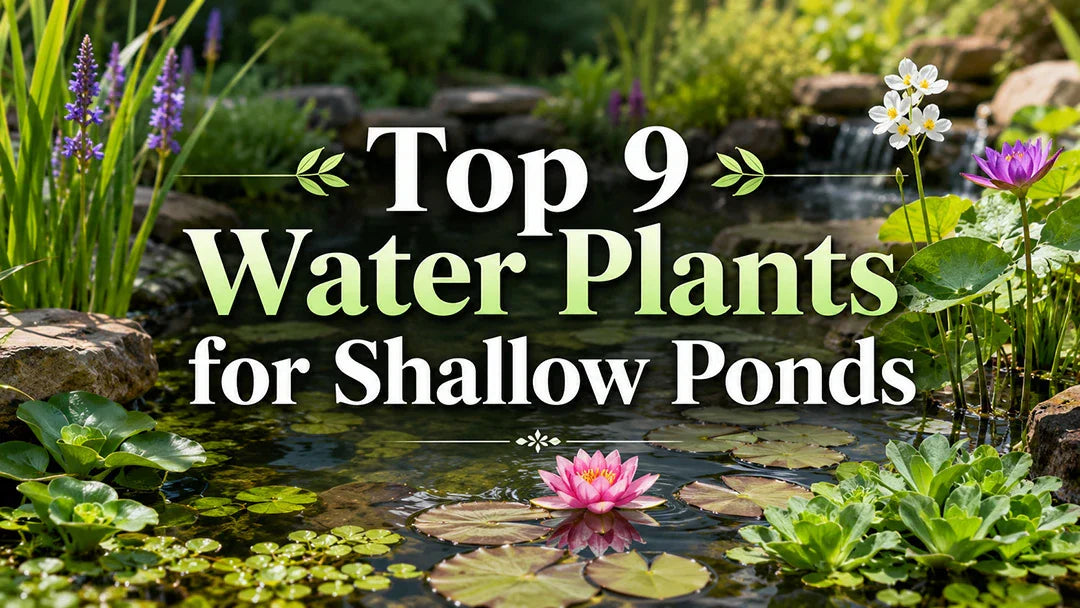
Shallow ponds are appearing in more and more home gardens. Many people are turning to them because it's a more approachable option. It's simpler to maintain, requiring little to no deep digging. However, there are challenges associated with a shallow pond. People often think that it's all about the plants, but it's more than that. Some plants will thrive in a shallow pond environment, while some may struggle. Let's look at nine different types of water plants that are great for a shallow pond.
Understanding Shallow Ponds and the Significance of Plant Selection
Shallow ponds do not act the same as deep ponds. Water warms up quicker, for one thing. Light can reach the bottom easily. This makes a difference for plant growth and the balance of the water itself.
Plants in a shallow pond are not merely aesthetic additions; they can also control algae, minimise temperature fluctuations, and support small aquatic animals. Incorrect plant choice can result in overstocking or muddied waters.
It is also important that when one is using small pond plants, these remain small, since otherwise over-performing species can easily outgrow small areas. Therefore, small ponds can be filled with carefully chosen plant species, rather than those that merely fill up an area according to quantity, not quality.
A good balance between the three types of aquatic plants — floating, marginal, and submerged — is usually the best approach. They are all important. If any of the three types is lacking, problems may arise.
Top 9 Water Plants for Shallow Ponds
Floating Water Plants for Small Ponds
Floating plants shade the water, slowing the growth of algae. Less is more in a shallow pond.

1. Water Lettuce (Pistia)
Water lettuce is free-floating and forms soft rosettes. It grows well during the warm months. In shallow ponds, it must be thinned frequently to ensure it does not grow thick enough to stop light from reaching other submerged plants.
2. Duckweed (Lemna)
Duckweed is small but mighty. It can spread quickly and gather nutrients. Many aquatic gardeners enjoy its beauty, then soon learn to manage it carefully.
3. Frogbit (Limnobium)
Unlike duckweed, frogbit is a lot tamer-looking. The small round leaves are very natural-looking and are best used in small ponds.
Marginal Water Plants for Shallow Ponds
Marginal plants grow at the edges. They provide visual anchors for the pond and blend it in with the garden setting.

4. Dwarf Cattail (Typha minima)
Unlike other cattails, it remains short in height. This provides height without dominating the pond.
5. Pickerel Plant (Pontederia)
The pickerel plant has erect foliage and blossoming flowers. These have low watering requirements and are attractive to beneficial insects.
6. Sweet Flag (Acorus)
Sweet flag is very forgiving. It can thrive in changing water levels, especially at soft water pond edges.
Submerged Water Plants for Small Ponds
Hard workers, they toil away quietly underwater. The primary function of submerged aquatic plants is to contribute to water health.

7. Anacharis (Elodea)
It is often used in a beginner's pond as it grows well and helps to increase the level of dissolved oxygen in the water.
8. Hornwort (Ceratophyllum)
Hornwort does not require planting into the soil. It will float on the surface of the water and will absorb any excess nutrients.
9. Dwarf Eelgrass (Vallisneria)
This type of plant grows at a height that is less than that of regular eelgrass. It is well suited to a shallow pond.
Plant Layout and Low-Effort Maintenance of Shallow Ponds
Layout is much more important than one would think. A shallow pond appears calmer if an open area of the water surface is visible. Plants crowded too tightly together may stress or decay.
- Floating plants should never cover the total area; one-third coverage should be adequate.
- Marginal plants are best grouped, not spaced evenly.
- Submerged aquatic plants require soft water currents. If water movement is lacking, water may stagnate in a shallow pond. A small fountain pump can provide water movement to keep oxygen levels high and prevent dead zones. Many people use small solar-powered pumps like this Poposoap 12W 160GPH Solar Water Fountain Pump to circulate water in their pond.
Conclusion
Decisions must be made in shallow ponds. If proper plants are used with consideration of space and balance, the pond will stay clean and look good. Floating plants control light, marginal plants provide shape, and underwater plants keep water quality good.
The aquatic plants for a shallow pond do not need to be exotic or hard to find, but a good group of the right kind of plants is much better than a selection of miscellaneous ones. This makes maintenance easy too.
Solar-powered fountain pumps can also be an alternative for your pond: browse Poposoap Solar Fountain Pumps.
If floating plants interest you further, this guide will give you more insight: The Ultimate Guide to Floating Aquatic Plants for Your Pond.

SPF130 8W 80GPH Solar Pond Filter Fountain with Battery
$59.99
Solar pond filter with battery backup: 8W panel + 3000mAh battery, multi-stage media, quiet dry-run protection. Solar powered pond filter with battery backup.
Frequently Asked Questions
Are Shallow Ponds More Difficult to Maintain Compared to Deep Ponds?
Not usually. With the right plants, they can be easier.
How Many Plants Should a Shallow Pond Contain?
Enough to balance the water, but not enough to crowd it.
Do Shallow Ponds Require Filtration?
A little light circulation can also help. Can shallow ponds survive winter? Yes, with hardy plants and trimming.

Leave a comment
All comments are moderated before being published.
This site is protected by hCaptcha and the hCaptcha Privacy Policy and Terms of Service apply.