

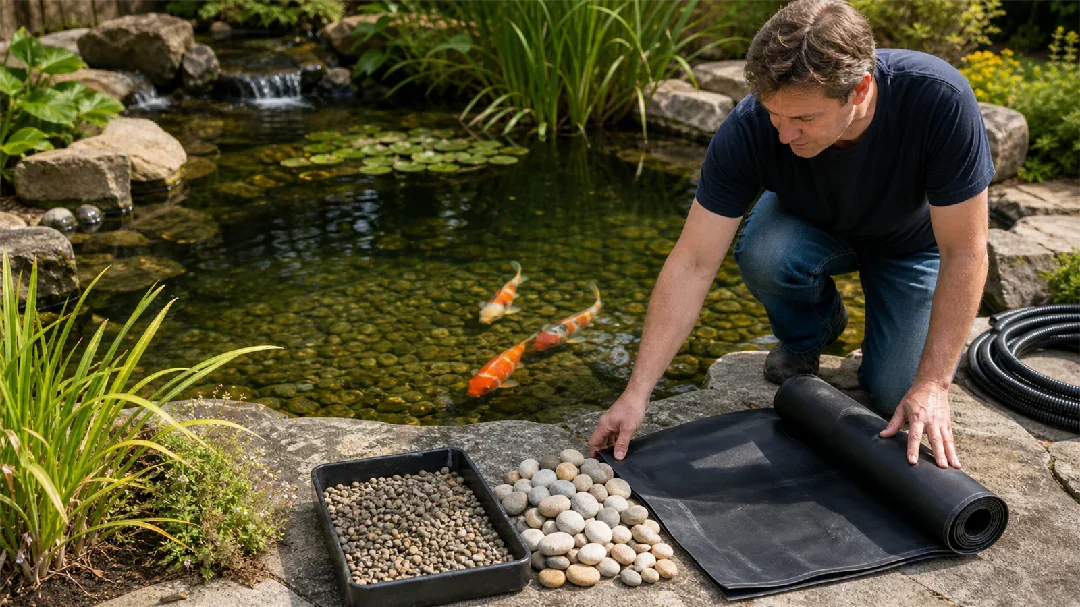
In summary, the decision on what to put at the bottom of a fish pond may not always involve additional materials. However, a pond without additional material can be just as functional, and even more convenient in some cases, than its opposite. Thus, when designing the bottom of a fish pond, consider all possible variants and evaluate their advantages and disadvantages.
Do You Actually Need Something at the Bottom of Your Fish Pond?
Is it necessary to lay additional materials at the bottom of the pond?
No, there is no necessity to place anything other than the liner at the bottom of the fish pond.
Bare-Bottom Ponds
A bare liner bottom design is one of the most popular fish pond designs.

Advantages:
- Ease of cleaning
- Visibility and quick removal of debris
- Optimal control over water quality
Disadvantages:
- Less natural appearance
This pond design is popular in koi fish ponds to eliminate hidden debris.
Gravel-Bottom Ponds
Placing gravel at the bottom of the pond is also a popular design decision.

Advantages:
- More natural appearance
- Creating a surface for beneficial bacteria
Disadvantages:
- Waste accumulation between stones
- Cleaning difficulties
Why Are There Different Opinions About This Matter?
Some users tend to opt for cleanliness, while others prefer a more natural appearance. Ultimately, the dispute arises due to the conflict between maintaining the system and its aesthetic side.
Most Common Materials for the Bottom of the Pond and Their Pros and Cons
What materials are usually placed at the bottom of the fish pond?
Common materials include liner, gravel, sand, and soil.
Pond Liner With No Additional Material
This is the simplest bottom design.
Advantages:
- Easiest to maintain
- Best solution for fish
Disadvantages:
- Poor aesthetics
Gravel or Pebbles
One of the most common bottom materials for ornamental ponds.
Advantages:
- Natural appearance
- Surface for beneficial bacteria
Disadvantages:
- Accumulation of debris
- Regular cleaning required
Sand
Some ponds feature sand at the bottom for a softer touch.
Advantages:
- Smooth surface
- Natural appearance
Disadvantages:
- Movement
- Possible water clouding
Soil or Mud
A soil-based bottom design is mainly used for wildlife ponds.
Advantages:
- Good for plants
Disadvantages:
- Not suitable for fish ponds
- May reduce water clarity
Which Materials May Cause Complications in the Future?
Materials such as gravel or soil can accumulate organic waste. In turn, this may lead to low water quality and affect fish.

What Is the Best Bottom Material for a Fish Pond?
What is the optimal pond bottom material?
The choice of material largely depends on the type of pond and maintenance preferences.
For Fish-Oriented Ponds
A bare bottom may be the best design.
Reasons why:
- Easier to clean
- Less debris accumulation
- Stable water quality
For Decorative Ponds
A gravel bottom may be an option; however, it will require more cleaning effort.
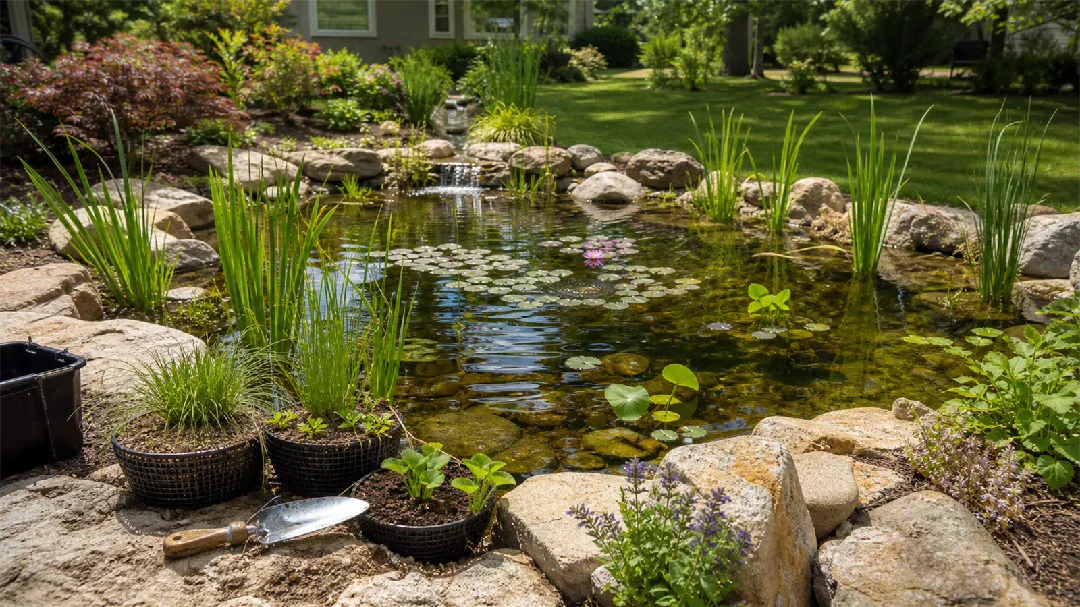
For Ponds With Vegetation
Mixed bottom designs may be employed, though they will require more maintenance.
Keeping the Bottom of the Pond Clean
If a bare-bottom design is selected, then a good filtration system will be necessary to ensure stable water quality.
Pond filters help:
- Move water around the system
- Reduce waste accumulation
- Ensure overall balance
Products like Poposoap solar fountain filters may be helpful in this situation. Filters will aid in reducing debris and make it easier to maintain the bottom of the pond.

A Simple Approach to Determining the Best Bottom Material for Your Pond
How can you make the process of choosing a pond bottom simpler?
Select based on the amount of cleaning and maintenance.
Guidelines for Selecting the Bottom of the Pond
- Desire for easy maintenance → bare bottom
- Desire for a more natural appearance → gravel
- Desire for vegetation → mixed design
Consider the Future
While some solutions may seem attractive now, they may be problematic in the long term.
Thus, a more simplistic design is usually preferable.
Conclusion
It is impossible to determine once and for all what material should be placed at the bottom of the pond.
A bare bottom provides:
- Ease of cleaning
- Control over the system
A gravel bottom offers a more natural appearance and visual appeal.
If you want to avoid excessive maintenance, the simplest solution will be preferable.
Poposoap products are optimized for simplicity. Lightweight design, fast installation, and ease of maintenance are the key features of Poposoap products. Any pond bottom may be maintained efficiently with a good filtration system.

SPF326 20W 280GPH Solar Pond Filter Fountain
$119.99
Clean and oxygenate your pond with this 20W solar pond filter pump. Eco-friendly 280GPH flow ideal for small to medium backyard water features.
FAQ
1. Do fish need gravel at the bottom of the pond?
Fish may be comfortable even in bare-bottom ponds.
2. Is it dangerous to put gravel into ponds?
Gravel may be fine, but it may trap debris.
3. Can I change my pond bottom later?
Yes, though it may require pond draining.
4. How can I keep my pond bottom clean?
Proper filtration and maintenance will be enough.

Leave a comment
All comments are moderated before being published.
This site is protected by hCaptcha and the hCaptcha Privacy Policy and Terms of Service apply.