

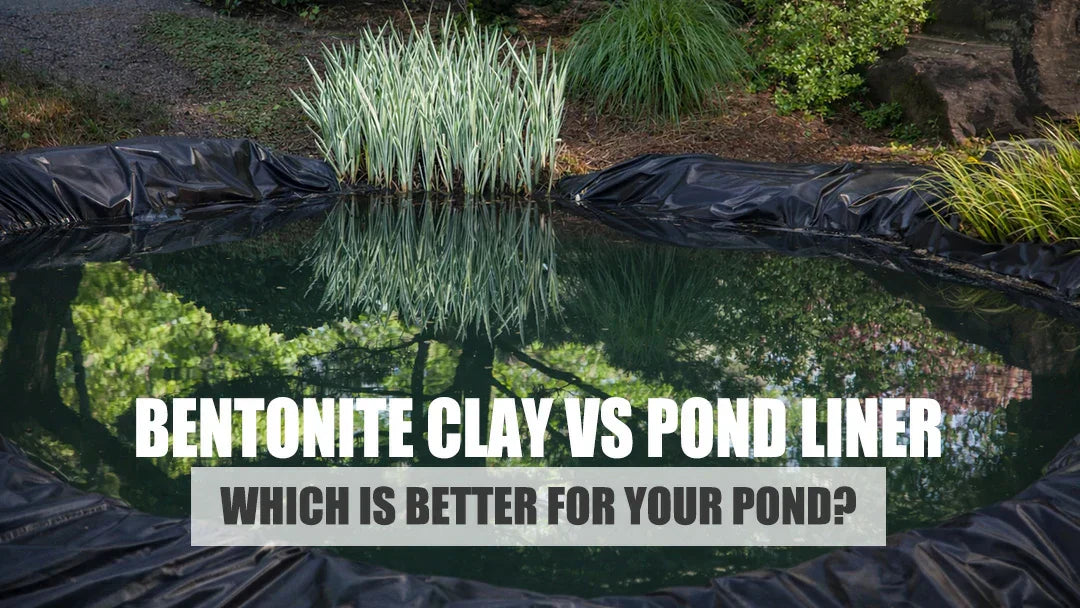
Stopping leaks in ponds is one of those things that one does not take seriously until it goes wrong.
It is slow, frustrating, and costly to correct when your pond is finished.
I suspect most pond owners are faced with the same initial questions. Will it seal the pond? How long will it last? What happens in a few winters? And is the cheap option really cheap in the long run?
In this article, bentonite clay vs. pond liner will be discussed in order to compare their effectiveness in real-world applications and to determine which option is better for most ponds.
Bentonite Clay: A "Natural" Solution with Real Limitations

Bentonite clay has been suggested as a method of naturally lining a pond. It works by expanding and filling in small spaces in soil when exposed to water. Well and good.
The problem is that bentonite only performs well if everything is close to perfect.
There must also be sufficient fine material in the soil beneath the pond to trap the clay particles in place. Sandy soil, loose gravel, or organic material will break this seal very easily. It only takes a few disturbances, such as roots growing through the base or animals digging in the surrounding soil, to cause more leaks to form.
Another issue is time. Bentonite does not remain uniformly distributed forever. The effect of seasonal drying and freezing causes it to lose strength over time. Once there is evidence of leaking, it is not easily traced. Repairs require draining the water and reworking the base.
In view of this, bentonite is now seldom employed as a standalone solution in modern ponds.
Why Underlayment and Pond Liners Go Hand-in-Hand

Most reliable ponds use a layered system rather than depending on the chemistry of the soil.
The pond underlayment, a protective fabric, comes in direct contact with the ground, helping to absorb pressure, smooth out uneven ground, and prevent sharp stones or tree roots from damaging the pond. Above this, a pond liner provides a waterproof layer.
For example, if you use a 10' x 10' Pond Underlayment and combine it with a 10' x 10' 45mil EPDM Pond Liner, you will have an extremely stable and predictable base. Not only will the liner be protected, but the water will stay where it is supposed to stay.
Pond Liners Explained: EPDM vs. HDPE Pond Liners
A pond liner completely separates water from the soil. Once the liner is installed in the correct position, water leaking is not dependent on the quality of the soil compaction.
EPDM vs. HDPE Pond Liner: What's the Difference?
Generally speaking, the deciding factor in an EPDM versus HDPE pond liner debate is the installation experience.
EPDM is very flexible. It stretches, folds, and fits into curves very easily. It is perfect for use in ponds that have shelves, planting areas, or interesting shapes. It is forgiving if some installation errors are made, making it ideal for do-it-yourself enthusiasts.
HDPE, on the other hand, is a rigid material. It is best used in large, simple ponds that have straight edges. It is extremely strong yet rigid, meaning that while it will withstand bends, sharp folds will cause stress and repairs are more complicated.
Both materials are durable and UV-resistant. Additionally, repairs needed for EPDM are easier compared to those needed for HDPE.
For most backyard ponds, EPDM is simply easier to work with. Something like a 45mil EPDM Pond Liner provides flexibility without sacrificing lifespan.
Determining the Best Pond Liner Materials for Practical Application
No single material is necessarily the best choice for a pond liner. The best choice depends on how that pond is to be used.
For small ponds, irregular shapes, or garden features, EPDM works well. This material can bend without stressing and can be installed without special equipment.
Large commercial-style ponds may require HDPE, but only if installation is done by a professional.
Cost is a confusing factor for consumers. Bentonite clay appears to be a low-cost option, but repeated water loss, repair costs, and maintenance add up. Although a liner has a higher upfront cost, it eliminates guesswork.
For a beginner, simple systems are important. With an all-in-one package like our 4' x 4' Pond Advanced Kit | 5-in-1 Filter, Waterfall, Lights, Pond Liner & Underlayment, there are no compatibility concerns.
This method is particularly useful for first-time pond builders.

Where Can I Buy Pond Liner?
Not all liners are made with long-term pond usage in mind. Cheap materials tear easily and degrade faster in the sun.
For a more specialized source, a pond supply house will generally be a much safer option than a hardware store. They will often provide thickness rating information, UV resistance information, and underlayment materials suitable for constant water exposure.
Conclusion
When it comes to the comparison between bentonite clay and pond liner, the most important element is reliability. Whereas the first depends on the soil and maintenance, the second promises a long-lasting seal.
When comparing EPDM and HDPE liners, it all comes down to the needs of the project, as EPDM liners are best suited for residential ponds.
However, the best and most reliable means of preventing leakage in a pond involves the use of a layered system comprising an underlayment and a liner.
READ MORE: Pros and Cons of Pond Liner vs. Preformed Ponds

10' x 10' 45mil EPDM Pond Liner
$139.00
10' x 10' EPDM rubber pond liner in durable 45 mil thickness. Flexible, UV-resistant, fish-safe liner for small pond builds and irregular water garden shapes.
FAQs
Is It Safe to Use Bentonite Clay in Fish Ponds?
Yes, but failure usually occurs if the soil conditions are not optimum.
What Type of Pond Liner Will Last the Longest?
EPDM and HDPE have the capability to last for decades if they are properly installed and an underlayment is used.
Do I Really Need an Underlayment Underneath a Pond Liner?
Yes. It helps prevent punctures and extends the service life of the liner.
Is It Possible for a Novice to Install a Pond Liner on Their Own?
Yes. EPDM liners, as well as full kits, are available for do-it-yourself installation.

Leave a comment
All comments are moderated before being published.
This site is protected by hCaptcha and the hCaptcha Privacy Policy and Terms of Service apply.